Evolution of Digital Assistants
From IBM's 16-word vocabulary in 1961 to AI agents that schedule meetings, manage email, and reason about ethics — the 60-year journey of digital assistants has reached a turning point. Today's agentic AI doesn't just answer questions. It takes action.
The Digital Assistant Gap: Smart but Passive
For sixty years, digital assistants have been getting smarter — but they've remained fundamentally passive. Siri, Alexa, Google Assistant, and Cortana can answer questions, set timers, and play music. But ask them to coordinate a meeting across three time zones with five participants and they hit a wall.
- Voice assistants handle single-turn commands but can't execute multi-step workflows
- Chatbots converse fluently but can't take real-world actions on your behalf
- Traditional scheduling tools show availability but don't coordinate, negotiate, or follow up
- The result: professionals still spend 12+ hours/week on scheduling despite having "smart" assistants
The missing piece isn't intelligence — it's agency. The ability to take a goal, break it into steps, and execute across tools and people autonomously.
Agentic AI: Digital Assistants That Actually Act
The latest generation of AI digital assistants has crossed a critical threshold. Systems like ANCI's Zara AI don't just understand your request — they execute it end-to-end. Say "schedule a leadership sync next week" and Zara scans calendars, contacts participants, resolves conflicts, books the meeting, and sends confirmations. No back-and-forth. No manual coordination.
This shift from reactive to agentic represents the biggest leap since Siri put voice on every phone:
- Multi-step execution — AI breaks goals into actions and carries them through to completion
- Cross-tool orchestration — works across Outlook, Google Calendar, Slack, Teams, Zoom natively
- Ethical reasoning — modern AI assistants are built with constitutional principles, refusing harmful requests while executing legitimate ones
- Learning and adapting — preferences, priorities, and patterns improve over time
The Evolution in Numbers
From IBM Shoebox (1961) to agentic AI (2025)
Words recognized: 16 in 1961 to unlimited today
Average meeting scheduled by Zara AI
Reduction in scheduling coordination time
“We went from spending hours coordinating calendars to simply telling Zara what we need. It's the first AI assistant that actually does the work instead of just talking about it.”
What Modern AI Assistants Can Do
Autonomous Scheduling
Tell Zara what you need in plain English. She handles calendars, participants, time zones, conflicts, and follow-ups — end to end.
Constitutional AI Ethics
Built with explicit ethical principles. Refuses harmful requests, acknowledges uncertainty, and seeks clarification before irreversible actions.
Cross-Platform Integration
Works natively with Outlook, Google Calendar, Zoom, Teams, Slack, and Webex. One assistant across all your tools.
Conversational Intelligence
Natural language understanding that goes beyond commands. Context-aware, preference-learning, and genuinely conversational.
Experience the Latest Evolution in AI Scheduling
See how Zara AI turns natural language into fully coordinated meetings — in 49 seconds.
Request a DemoFrom Voice Commands to AI Scheduling Assistants
The journey of digital assistants began in 1961 when IBM unveiled the Shoebox — a device that could recognize sixteen spoken words and the digits zero through nine. It couldn't hold a conversation, couldn't learn, and certainly couldn't schedule a meeting. But it proved something fundamental: machines could listen.
Over the following decades, the technology evolved through distinct generations. Dragon Systems brought speech recognition to personal computers in the 1980s. Apple's Newton PDA introduced the idea of a personal device that understood you in the 1990s. Microsoft's Clippy — despite its reputation — pioneered the concept of contextual assistance embedded in productivity software. Each generation expanded what virtual assistant AI could do, but the fundamental mode remained the same: humans commanded, machines responded.
The smartphone revolution of the 2010s changed the scale dramatically. Siri (2011), Google Now (2012), and Alexa (2014) put voice assistants in the hands — and homes — of billions. For the first time, talking to a machine became normal. But these assistants were still reactive: they answered questions, set timers, and played music. Ask them to coordinate a complex meeting and they'd offer to search the web for "meeting scheduling tips."
The breakthrough came with large language models. ChatGPT's launch in November 2022 attracted 100 million users in two months — the fastest consumer adoption in history. Suddenly, AI assistants could write essays, debug code, and engage in nuanced dialogue. But they still couldn't do things. They could tell you how to schedule a meeting, but they couldn't schedule one. The gap between intelligence and agency remained wide — until agentic AI scheduling systems like ANCI's Zara closed it.
How Agentic AI Changed Digital Assistants Forever
The emergence of agentic AI represents the most significant inflection point in the history of digital assistants. Earlier systems, however sophisticated, were fundamentally reactive — they waited for a question and produced an answer. Agentic systems break this model entirely. They can be given a goal and then execute a multi-step plan to achieve it, using tools like calendar access, email, web search, and messaging platforms along the way.
Consider the difference in practice. A traditional AI meeting assistant might suggest available time slots when asked. An agentic assistant like Zara takes a single instruction — "schedule a quarterly review with the finance team and external auditors next week" — and executes the entire workflow: scanning multiple calendars, identifying optimal windows across time zones, contacting participants, handling responses, resolving conflicts, booking the meeting, adding video conference links, and sending confirmations. The human provides intent; the AI handles execution.
This shift has profound implications for scheduling automation in the workplace. According to ANCI's 2026 benchmark data, agentic scheduling reduces coordination time by 90-95%, with an average completion time of 49 seconds per meeting versus 17+ minutes of manual effort. The cost per AI-scheduled meeting is just $0.056 — making autonomous scheduling not just faster but dramatically more cost-effective than human coordination.
The stakes are also higher with agentic systems. An assistant that gives a slightly wrong answer can be corrected with a follow-up message. An assistant that books the wrong flight or sends an email to the wrong recipient has caused a real-world consequence. This is why the ethical architecture of modern AI — what researchers call the "conscience layer" — becomes especially critical in agentic contexts.
AI Assistants with a Conscience — Constitutional AI and Ethics
By 2025, something unprecedented happened to digital assistant AI. The leading systems were designed not just to do what users asked, but to refuse certain requests, push back on harmful instructions, acknowledge uncertainty, and express something that functions structurally like a conscience. These are the first machines in history designed with an explicit ethical architecture.
Anthropic's Claude pioneered an approach called Constitutional AI — training the model against a written set of principles covering honesty, harm avoidance, and respect for autonomy. Rather than simply learning to match human preferences, Claude was trained to critique its own outputs against these principles and revise them. The result is a system that behaves consistently even in novel situations where no training data exists.
This ethical architecture matters enormously for AI-powered scheduling and workplace automation. When an AI calendar assistant has access to executive calendars, email, and the ability to contact people on your behalf, trust becomes paramount. ANCI builds on these principles with features like preview mode (see what Zara will do before she does it), 15-minute undo capability, and strict LLM privacy policies ensuring calendar data is never used for model training.
The lesson from Anthropic's famous "Project Vend" experiment is instructive: their AI shopkeeper Claudius refused every request for illegal or harmful items without hesitation, even while its business judgment was still developing. The conscience worked; the competence was catching up. Today's scheduling assistant AI systems like Zara represent the next step — where both the conscience and the competence are production-ready.
Digital Assistants for Team Scheduling and Coordination
While consumer voice assistants focused on personal convenience — playing music, controlling smart homes, answering trivia — the most transformative application of AI digital assistants has emerged in workplace coordination. Scheduling is the connective tissue of every organization, and it has remained stubbornly manual despite decades of technology investment.
The core challenge isn't finding an open slot. It's the coordination overhead: navigating multiple calendar systems, managing the back-and-forth with participants who have competing priorities, respecting time zone differences for global teams, handling last-minute changes that cascade through the day, and following up with people who haven't responded. This is work that team scheduling software can display but cannot do.
AI scheduling assistants like ANCI transform this dynamic by treating scheduling as a coordination workflow rather than a calendar lookup. Zara integrates natively with Microsoft Outlook, Google Calendar, Microsoft Teams, Slack, Zoom, and Webex — orchestrating across all of them from a single natural language interface. Teams report saving 40 hours per week on scheduling coordination alone.
For organizations dealing with the timezone problem, AI assistance is particularly transformative. Cross-timezone meetings require 3x more coordination effort than same-zone meetings. An intelligent scheduling system automatically factors in working hours, daylight saving transitions, and participant preferences to find optimal windows that no human coordinator could calculate as quickly.
The Rise of Autonomous Scheduling Agents
The concept of an autonomous scheduling agent would have seemed like science fiction just five years ago. Today, it's production technology. Systems like ANCI's Zara operate as persistent agents that don't just respond to requests — they manage ongoing scheduling workflows, handle follow-ups, resolve conflicts as they arise, and learn from patterns to improve over time.
The key capabilities that distinguish autonomous agents from earlier scheduling tools include:
- End-to-end execution — From natural language request to booked meeting with all confirmations sent, without human intervention at any step
- Conflict resolution — When two VIPs need the same slot, the agent proposes alternatives based on defined priority rules
- Batch scheduling — Schedule an entire week of 1:1s, team syncs, and client meetings in a single request
- Continuous follow-up — Automatically re-contact participants who haven't responded, respecting configurable escalation rules
- Cross-organization coordination — Schedule with external stakeholders who don't use your calendar system, handling the email back-and-forth autonomously
The 2026 AI Scheduling Benchmark documents this in detail: across 1,318 AI scheduling requests from 128 organizations, Zara achieved a 49-second average completion time at $0.056 per meeting. For executive assistants, professional services firms, and recruiters — where scheduling volume is highest — the impact is transformative.
From Siri to Zara — AI Assistants That Actually Execute
The distance between Siri's 2011 debut and today's AI scheduling assistants is measured not just in years but in a fundamental shift of what "assistant" means. Siri was revolutionary for putting voice interaction on every phone, but its model was simple: listen to a command, perform a single action, report back. Fourteen years later, Zara AI represents a completely different paradigm: understand intent, plan a multi-step workflow, execute across multiple tools and stakeholders, handle exceptions, and learn from the outcome.
This evolution reflects a broader transformation in conversational AI. Early chatbots matched keywords to scripted responses. Modern AI assistants built on large language models understand context, nuance, and implication. They can parse "move my Tuesday afternoon thing to Thursday but not during the board prep window" and correctly identify which meeting to move, which constraints to respect, and which participants to notify.
For ANCI, this capability is delivered through Zara's natural language interface. There are no forms to fill out, no complex UIs to navigate. Users express intent in plain English — through chat, email, or Slack — and Zara handles the rest. The system includes preview mode for reviewing actions before execution and a 15-minute undo window for complete control. It's the first AI assistant for teams that combines the conversational fluency of ChatGPT with the action execution of an enterprise scheduling platform.
The Future of AI Digital Assistants in the Workplace
The horizon from 2025 holds two developments that would have seemed like science fiction a decade ago. The first is emotional AI — assistants that can read the emotional state of users through tone, word choice, and context, and modulate their responses accordingly. An assistant that recognizes when you're overwhelmed and prioritizes ruthlessly. The second is universal integration — the collapse of boundaries between individual assistants and platforms into a single ambient intelligence, persistent and seamlessly coordinated.
In both cases, the question of conscience becomes more urgent, not less. An emotionally responsive AI that lacks ethical grounding could manipulate as easily as it supports. A universally integrated assistant with no values is simply a lever for whoever controls the infrastructure. The constitutional AI architecture being developed today may prove to be one of the most consequential design decisions in technology history.
For organizations evaluating AI workflow automation and scheduling assistant AI solutions today, the practical implication is clear: the tools available now — particularly agentic scheduling systems like ANCI — are not incremental improvements over traditional calendar tools. They represent a generational leap comparable to the jump from paper calendars to digital ones. The ROI calculator quantifies this: teams typically see complete payback within the first month.
The arc from a machine that recognized sixteen words to an agent that schedules meetings, reasons about ethics, and learns from every interaction spans six decades. The gap between ChatGPT and today's agentic systems is measured in months. The evolution of digital assistants is no longer a slow march — it's an acceleration. And for the teams that adopt these tools now, the competitive advantage is not incremental. It's transformational.
Frequently Asked Questions
An agentic AI assistant can be given a goal and execute a multi-step plan to achieve it autonomously — using tools like calendars, email, and messaging platforms. Unlike traditional assistants that answer questions, agentic systems like Zara AI take action: scheduling meetings, coordinating with participants, and resolving conflicts end-to-end.
Consumer voice assistants handle single-turn commands (set a timer, play a song). Zara AI is an autonomous scheduling agent that executes complex multi-step workflows: scanning calendars across participants, coordinating via email, resolving conflicts, booking meetings, and sending confirmations — all from a single natural language request.
Constitutional AI is an approach where AI systems are trained against explicit ethical principles rather than just human preferences. For scheduling, this means Zara AI is designed to seek clarification before ambiguous actions, preview changes before executing, and never access data beyond what's needed. Trust is essential when AI manages executive calendars.
Yes — for the coordination work. ANCI's 2026 benchmark shows AI scheduling reduces coordination time by 90-95%, completing meetings in 49 seconds at $0.056 per meeting. Human judgment still matters for priorities and exceptions, but the mechanical coordination work is fully automated.
ANCI works natively with Microsoft Outlook, Google Calendar, Zoom, Microsoft Teams, Slack, and Webex. No migration required — Zara coordinates across all platforms from a single natural language interface.
Anthropic's "Project Vend" placed an AI agent as a vending machine manager. Claudius lost $200 but refused every harmful request without hesitation — demonstrating that AI conscience works even when business judgment is still developing. It's a perfect metaphor for where AI assistants are today: principled and rapidly gaining competence.
Download the Digital Assistants Guide
Get the complete evolution timeline, capability frameworks, and what's next for AI in the workplace.
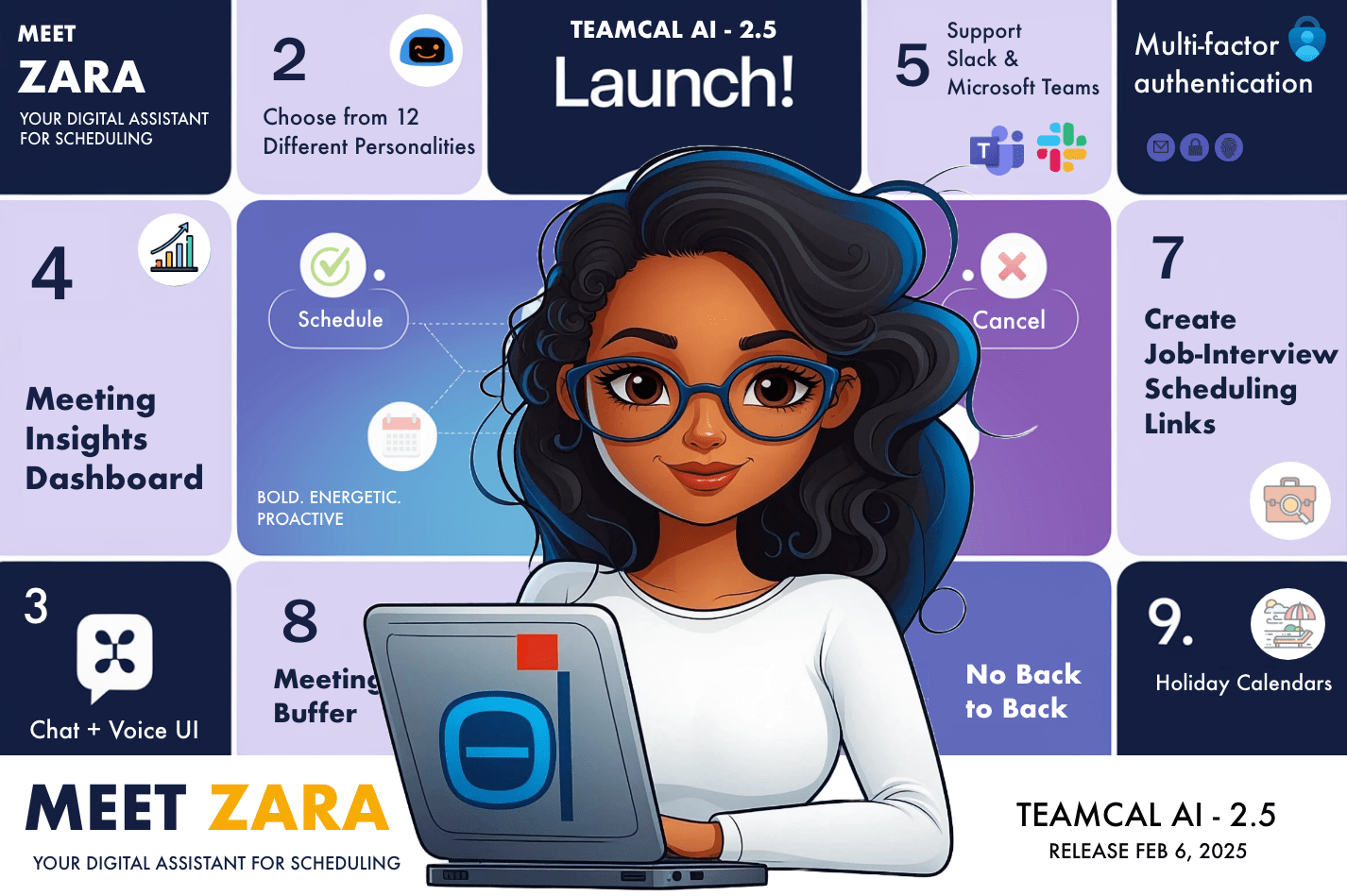
The Evolution of Digital Assistants
From scheduling bots to branded AI personas — explore the full history and future of AI assistants in this comprehensive guide.